
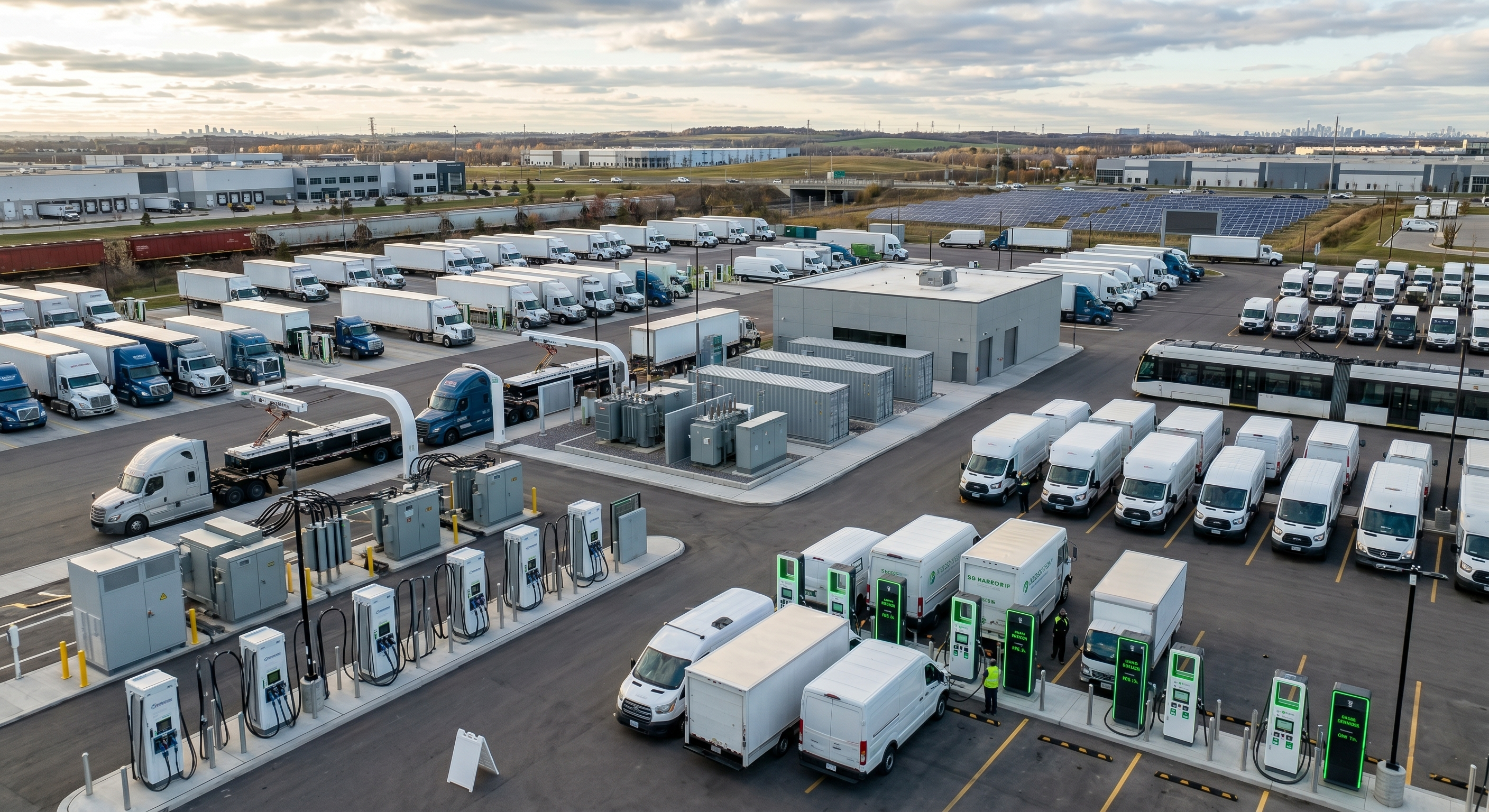
The transition to cleaner transportation continues to accelerate across North America as governments and industry leaders invest in infrastructure, innovation, and fleet electrification. This week’s developments highlight major funding initiatives to expand EV charging networks, financial incentives to accelerate commercial vehicle electrification, and strategic partnerships aimed at building the infrastructure needed to support the next generation of electric and autonomous mobility.
1. Canada Invests $25 Million to Expand EV Charging and Advance Battery Innovation
The Government of Canada has announced a $25 million investment supporting 33 projects designed to accelerate the adoption of zero-emission transportation. The funding package focuses on expanding EV charging infrastructure, advancing battery technologies, and modernizing commercial transportation fleets.
The largest share of the funding, $9.7 million through Natural Resources Canada’s Zero Emission Vehicle Infrastructure Program (ZEVIP), will support 23 projects that will install more than 850 new EV chargers across the country. Most of these chargers will be deployed in Quebec and will include a combination of Level 2 and DC fast chargers located in public spaces, workplaces, multi-unit residential buildings, and along major transportation corridors.
Several projects address specialized transportation needs. Propulsion Québec will deploy 320 Level 2 chargers throughout the province, while Les Pétroles R.L. Inc. will install 62 chargers, including 34 fast-charging units. Additional projects include heavy-duty truck charging infrastructure at IKEA’s Beauharnois facility and charging stations supporting ambulance fleets at the University Hospital of Montreal. Beyond charging infrastructure, Canada is investing $8 million through its Energy Innovation Program to support six projects focused on battery performance improvements, vehicle-to-grid charging solutions, and charging optimization in remote and northern climates.
The remaining $7.9 million will support cleaner commercial transportation through the Green Freight Program, helping fleets transition to lower-emission vehicles and alternative fuel technologies. These investments support Canada’s broader climate objectives, including the goal of achieving 100% zero-emission vehicle sales by 2035 and expanding the national public charging network to 50,000 chargers by 2030.
2. California Launches $1 Billion Electric Truck Rebate Program
California has introduced a major financial incentive program aimed at accelerating the adoption of electric commercial vehicles. The newly launched California Clean Fuel Reward (CCFR) will provide more than $1 billion in rebates through 2030, making it one of the largest utility-administered electric truck incentive programs in the United States.
Applications will open on June 26, with $250 million available during the program’s first year. Funded through California’s Low Carbon Fuel Standard, the initiative supports purchases and leases of new battery electric medium and heavy duty vehicles ranging from Class 2b to Class 8.
Rebates will vary by vehicle category, ranging from $7,500 for smaller commercial vehicles to as much as $120,000 for larger truck classes. Eligible vehicles include delivery vans, box trucks, electric semis, and drayage trucks used in freight transportation.
California officials view the program as both an environmental and economic development strategy. By reducing upfront vehicle costs, the initiative aims to encourage fleet operators to adopt zero-emission technologies while addressing air pollution challenges near ports, freight corridors, and logistics centers.
The CCFR complements the state’s existing Clean Truck and Bus Voucher Incentive Project (HVIP), which has already supported more than 11,600 clean commercial vehicles with over $1 billion in funding. With zero-emission vehicles accounting for nearly 23% of new medium- and heavy-duty vehicle sales in California during 2024, the state continues to position itself as a leader in commercial transportation electrification.
3. Voltera and Revel Expand Urban EV Charging Infrastructure
Voltera and Revel have announced plans to combine their businesses, creating a larger EV charging infrastructure platform designed to support electric fleets, ride-hailing services, and autonomous vehicles in major urban markets across the United States.
Upon completion of the transaction, the combined platform is expected to include more than 1,000 charging stalls that are either operational or under development across 11 major U.S. metropolitan areas. This expanded network will create one of the country’s largest dedicated charging footprints serving fleet operators and autonomous vehicle customers, helping address the growing demand for reliable, high-capacity charging infrastructure.
The combined platform will focus on a customer-centric deployment strategy, aligning site selection, infrastructure design, and project timelines with the operational needs of fleet and autonomous mobility providers. Investment will be concentrated in high-value urban markets where demand for commercial EV charging is expected to grow rapidly.
Beyond fast-charging infrastructure, the company plans to explore complementary energy solutions, including battery storage, energy management systems, EV charging services for non-autonomous fleets, and integrated fleet support services. These initiatives aim to strengthen the broader EV ecosystem while improving charging accessibility, operational efficiency, and long-term infrastructure scalability.
This combination reflects the increasing importance of large-scale charging networks as cities prepare for the continued growth of electric transportation, commercial fleet electrification, and emerging autonomous vehicle technologies.
Looking Ahead
These two week’s developments highlight the growing momentum behind transportation electrification across North America. Governments are investing in EV charging infrastructure, battery innovation, and fleet electrification programs, while private-sector partnerships are building the large-scale charging networks needed to support commercial fleets and future autonomous mobility services.
As EV adoption continues to expand, investment in charging accessibility, energy management solutions, battery technologies, and fleet-focused infrastructure will play a critical role in supporting the next phase of clean transportation growth.
Stay Connected
The renewable energy and transportation sectors continue to evolve rapidly as new policies, technologies, and investments reshape the future of mobility. Stay connected for insights covering clean energy developments, EV infrastructure expansion, battery innovation, and emerging market trends from around the world.
👉 Connect with us on LinkedIn: Energiee Motion
References
- Drive Tesla Canada – Canada commits $25 million to add 850 EV chargers, advance battery technology
https://driveteslacanada.ca/news/canada-commits-25-million-to-add-850-ev-chargers-advance-battery-technology/ - Electrive – California launches $1 billion rebate programme for electric trucks
https://www.electrive.com/2026/05/18/california-launches-1-billion-rebate-programme-for-electric-trucks/ - Business Wire – Voltera and Revel Announce Combination to Create Scaled EV Infrastructure Platform for Fleet and Autonomous Mobility
https://www.businesswire.com/news/home/20260526724412/en/Voltera-and-Revel-Announce-Combination-to-Create-Scaled-EV-Infrastructure-Platform-for-Fleet-and-Autonomous-Mobility
