
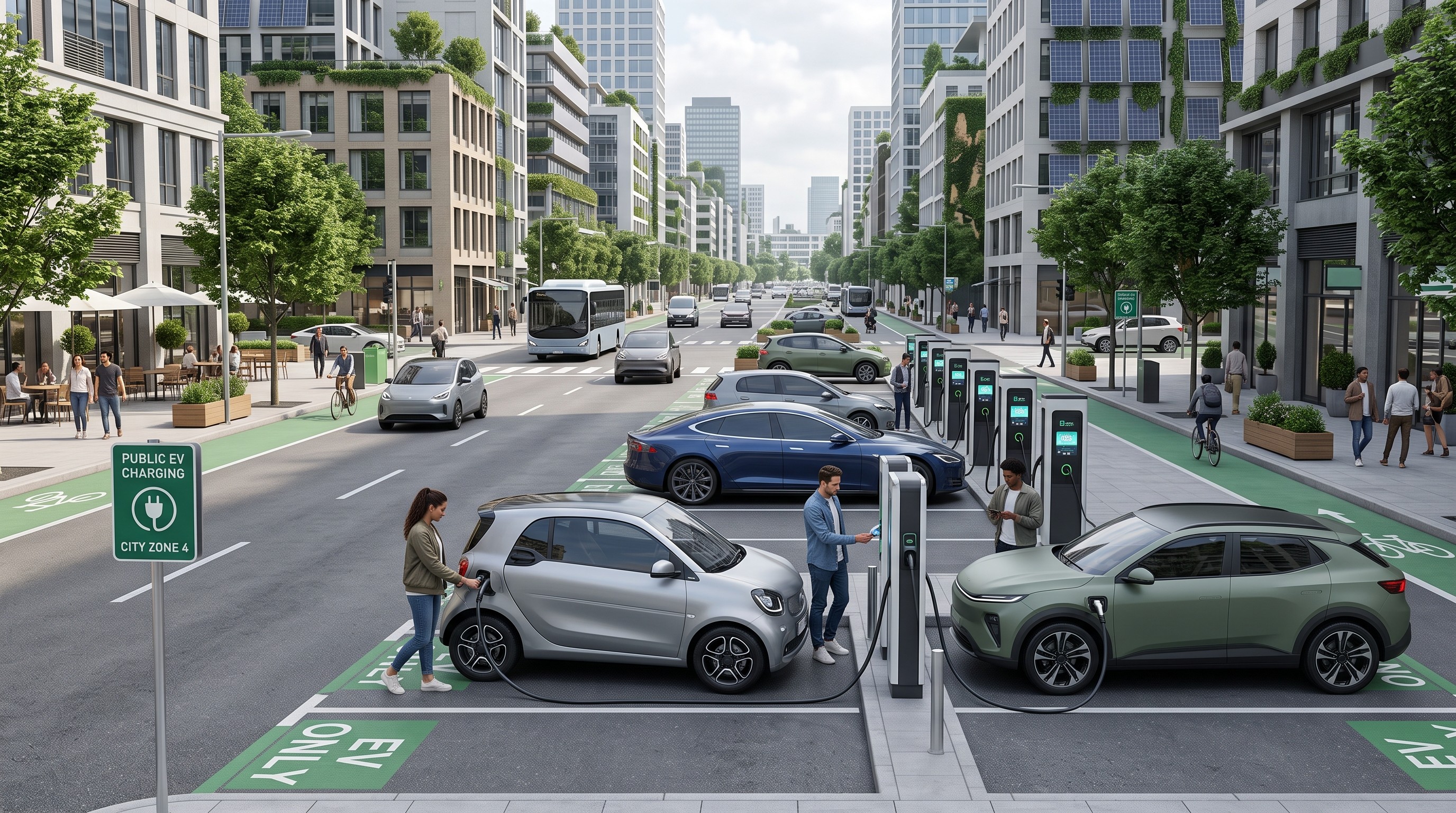
The electric vehicle (EV) charging industry continues to evolve as infrastructure expands, charging technologies advance, and new financial incentives emerge for EV owners. This week, we explore Canada’s growing fast-charging network and improving utilization rates, the United States’ milestone of surpassing 80,000 public fast-charging ports, and the growing opportunities for Canadian drivers to earn rewards through home charging under the country’s Clean Fuel Regulations. Together, these developments highlight the importance of infrastructure investment, technological innovation, and supportive policies in advancing the transition toward sustainable transportation.
1. Canada’s EV Fast-Charging Network Expands as Utilization and Demand Recover
Canada’s public EV fast-charging infrastructure continued to expand in the third quarter of 2026, reflecting sustained investment in charging accessibility and network development. According to Paren’s Q3 2026 State of the Industry report, the country added 391 new direct current fast-charging (DCFC) ports and 103 charging stations, bringing the national total to 9,615 ports across 2,740 stations. This represents a 26.8% year-over-year increase in charging ports, indicating that infrastructure development continues to progress alongside the Canadian EV market. Charging activity also strengthened during the quarter, with total sessions increasing from 3.0 million in Q2 to 3.8 million in Q3, while average utilization rose from 9.6% to 10.4%. Despite this quarterly recovery, utilization remained approximately 10% below its Q3 2025 level, highlighting the need for continued growth in charging demand.
Although network expansion and charging activity are showing positive momentum, financial sustainability remains a significant challenge for charging operators. According to Electric Mobility Canada, the industry’s estimated utilization threshold for financial sustainability is approximately 20%, considerably higher than the current national average of 10.4%. This gap suggests that many charging networks may continue to require government support while EV adoption and charging demand develop further. At the same time, Canada’s fast-charging market is becoming increasingly competitive. Tesla remains the country’s leading fast-charging operator but now accounts for less than one-third of public fast chargers, reflecting increased infrastructure deployment by other charging providers. Among newly deployed non-Tesla charging connectors, the Combined Charging System (CCS) represented 73.9%, followed by the North American Charging Standard (NACS) at 17% and CHAdeMO at 9.2%. The average number of ports per new non-Tesla station remained at 3.2, while Tesla’s average declined from 16.3 in Q2 to 9.8 in Q3.
Charging reliability and affordability also remain important factors influencing the EV ownership experience. Canada’s average fast-charging reliability score declined slightly from 91.4 in Q2 to 91.1 in Q3, emphasizing the importance of ongoing maintenance, network performance, and infrastructure protection. Challenges such as charging cable theft and vandalism continue to create operational difficulties for charging providers. Meanwhile, the national average fast-charging price decreased from $0.50 to $0.49 per kWh, offering a modest improvement in charging affordability. Pricing structures vary across the network, with 40% of stations using fixed per-kWh pricing, 31% charging by time, 23% using power-based pricing, and 6% adopting time-of-use energy pricing. These differences demonstrate the range of business models currently being used as charging operators work toward balancing accessibility, operating costs, and long-term profitability.
Looking ahead, the Canadian charging industry is expected to benefit from continued investment in higher-powered charging infrastructure as newer electric vehicles become capable of faster charging speeds. Potential policy developments, including the anticipated National Charging Infrastructure Strategy and updates to the Zero Emission Vehicle Infrastructure Program, could further support network expansion. The possible entry of additional international EV manufacturers and charging providers may also introduce new competition and infrastructure investment opportunities. Overall, Canada’s Q3 2026 performance reflects continued progress in charging deployment and demand, although improving reliability, increasing utilization, and achieving financial sustainability will remain essential priorities for the industry’s long-term growth.
2. US Fast-Charging Network Surpasses 80,000 Ports as High-Power Infrastructure Accelerates
The United States reached a significant milestone in Q3 2026 as its public EV fast-charging network surpassed 80,000 charging ports for the first time. According to Paren’s State of the EV Charging Industry report, highlighted by EVwire, operators installed 4,106 new DC fast-charging ports across 664 new stations, bringing the national network to 80,964 ports across 14,614 stations. While infrastructure deployment continued, the pace of new installations moderated compared with the 4,618 ports added in Q2 2026 and 4,663 ports recorded in Q3 2025. This reflects a recurring quarterly deployment pattern, with slower growth early in the year, stronger installation activity during the second quarter, and a subsequent decline in the third quarter. Despite this moderation, charging demand continued to increase significantly, with drivers completing 50.4 million fast-charging sessions in Q3, representing 26% year-over-year growth. July alone recorded 17.6 million sessions, setting a new monthly record, while national charging utilization remained at 15.9%. Network reliability held steady at 93.9, although the average charging price increased to $0.540 per kWh, largely influenced by Tesla’s pricing adjustments.
Competition among charging network operators is also intensifying as more companies expand their public charging infrastructure. Tesla remained the largest contributor to new installations, adding 1,287 ports during the quarter, equivalent to 31.3% of all new deployments. Its share increased to 34.4% when including an additional 124 ports installed through Tesla Supercharger for Business locations. However, Tesla’s share of new installations continues to decline as competing networks increase their deployment activity. Ionna more than doubled its second-quarter rollout to 378 new ports, partly through the conversion of former Circle K sites, moving from seventh to second place in quarterly deployments. Walmart followed with 344 ports, while Red E, Electrify America, ChargePoint, Vialynk, and EVgo contributed 202, 186, 169, 152, and 136 ports respectively. Tesla continued to account for the largest portion of the installed national charging network, with 39,952 ports representing 49.3% of the total. Nevertheless, the increasing contribution from other providers indicates a progressively more diversified and competitive charging landscape.
Charging station design is also evolving, with operators increasingly developing larger locations that can accommodate more vehicles simultaneously. Newly opened non-Tesla stations averaged 5.0 ports in Q3 2026, compared with 4.1 ports during the same period in 2025. Stations with only one or two ports now account for less than one-third of new non-Tesla openings, down from nearly half previously. Electrify America, bp pulse, and Vialynk were among the operators developing sites with at least 20 ports, including Electrify America’s largest station to date, featuring 24 ports. Tesla’s newly opened Supercharger stations averaged 13.1 ports, up from 12.1 in Q2, and the company introduced 11 new locations with at least 24 charging stalls, including a 48-stall site in Fort Lauderdale, Florida. Meanwhile, connector deployment trends continue to reflect changing industry standards. Non-Tesla networks installed 677 NACS ports during Q3, representing approximately 23% of new connectors, compared with 22% in Q2 and 9% in Q3 2025. CCS remained the dominant connector type, accounting for approximately 74% of new non-Tesla installations. As of September 2026, the installed non-Tesla network included 38,105 CCS ports, 8,574 CHAdeMO ports, and 4,801 NACS ports, with some operators also beginning to introduce NACS-only charging locations.
Another significant development is the accelerating deployment of higher-powered charging infrastructure. Across all charging operators, 73% of newly installed ports in Q3 2026 were rated at 250 kW or higher, compared with 69% in Q2 and 60% a year earlier. Among non-Tesla networks, chargers rated at 400 kW or above accounted for 35% of new installations, a substantial increase from 10% in Q3 2025, making this the largest power category among newly deployed non-Tesla ports. Tesla also contributed to this transition by installing 303 new ports rated at 400 kW or higher across 26 sites equipped with its 500 kW V4 charging cabinets. The company now operates 42 sites featuring 487 ports rated at 500 kW. These developments demonstrate that the US fast-charging industry is progressing beyond network expansion alone, with increasing emphasis on higher charging capacity, larger station configurations, and improved infrastructure performance to meet growing EV demand.
3. Canadian EV Drivers Gain New Opportunities Through Home Charging Reward Programs
Canadian electric vehicle owners are gaining new opportunities to earn financial rewards from charging their vehicles at home through programs supported by the country’s Clean Fuel Regulations. These regulations require fuel suppliers to reduce the carbon intensity of the fuels they provide, with one compliance pathway involving the purchase of credits generated through eligible EV charging activity. Charging reward programs act as aggregators by registering qualifying home chargers, collecting eligible charging data, generating compliance credits, and sharing a portion of the resulting revenue with participating drivers. According to Charge News Canada, 20 home charging reward programs are currently operating across the country, creating additional financial incentives for EV owners while supporting Canada’s broader clean transportation objectives.
With multiple programs available, selecting a suitable provider requires careful consideration of eligibility requirements, equipment compatibility, and payment conditions. A newly launched comparison platform allows Canadian drivers to review all 20 programs through filters based on province, charger type, and payout schedule. Reward rates vary by provider and location, meaning that the potential earnings from home charging can differ between drivers. Most programs require charging equipment compatible with the Open Charge Point Protocol (OCPP), including commonly used smart charging systems, while a smaller number also support Tesla Wall Connectors directly. Some programs may have proprietary hardware requirements. These differences make it important for consumers to verify that their existing charging equipment qualifies before enrolling in a reward program.
One of the most important participation requirements is that each charger can be registered with only one reward program per calendar year. Enrolling the same charger with multiple providers during the same year could result in disqualification and the loss of potential rewards. Drivers who wish to change providers must leave their existing program before December 31 and register with the new program on or after January 1. However, switching requirements vary between operators, and some programs may require written notice or specific de-registration procedures. Understanding these conditions in advance is essential for maintaining eligibility and avoiding interruptions to reward payments. Drivers should also consider payment frequency, as many programs distribute rewards only once per year, typically during the first quarter of the following year.
Beyond advertised reward rates, home charging consumption and provincial program availability are important factors when estimating potential financial benefits. The newly introduced comparison platform includes an earnings calculator that uses a default annual home charging consumption of 3,500 kWh, which drivers can adjust based on their actual electricity usage. This allows consumers to compare estimated earnings across eligible programs and select options that better match their charging habits and equipment. While the financial benefits depend on individual circumstances and program conditions, the growing availability of home charging rewards demonstrates how clean fuel policies can create additional value for EV owners. As these programs become more accessible, they may help improve consumer awareness of the economic benefits associated with electric mobility while encouraging participation in Canada’s transition toward lower-carbon transportation.
Looking Ahead
The latest developments across Canada and the United States demonstrate how the EV charging industry is entering a new phase of growth and transformation. Canada’s expanding fast-charging network reflects continued infrastructure investment and improving utilization, while the United States is advancing toward larger, higher-powered charging stations to meet increasing demand. At the same time, Canada’s home charging reward programs highlight how environmental policies can create additional financial value for consumers. Moving forward, the industry’s success will depend not only on expanding charging infrastructure but also on improving network reliability, increasing affordability, strengthening financial sustainability, and ensuring that EV owners can benefit from accessible and efficient charging solutions.
Stay Connected
Stay informed about the latest developments in renewable energy, electric mobility, and sustainable infrastructure. Follow our Renewable Energy Insights series for weekly updates on emerging technologies, industry trends, and policies shaping the transition toward a cleaner and more sustainable energy future.
👉 Connect with us on LinkedIn: Energiee Motion
References
- Paren – Canadian EV Fast Charging — Q3 2026
https://www.paren.app/reports/canadian-ev-fast-charging-q3-2026 - EVwire – Paren data: US EV fast-charging network passes 80,000 ports in Q3, Tesla still on top, Ionna jumps to No. 2 in new ports
https://evwire.com/p/us-ev-fast-charging-network-q3-2026-paren-report - Charge News Canada – Get Paid to Charge at Home: Compare Every EV Charging Rewards Program in Canada
https://chargenews.ca/blog/ev-charging-rewards-canada-comparison-2026/
