
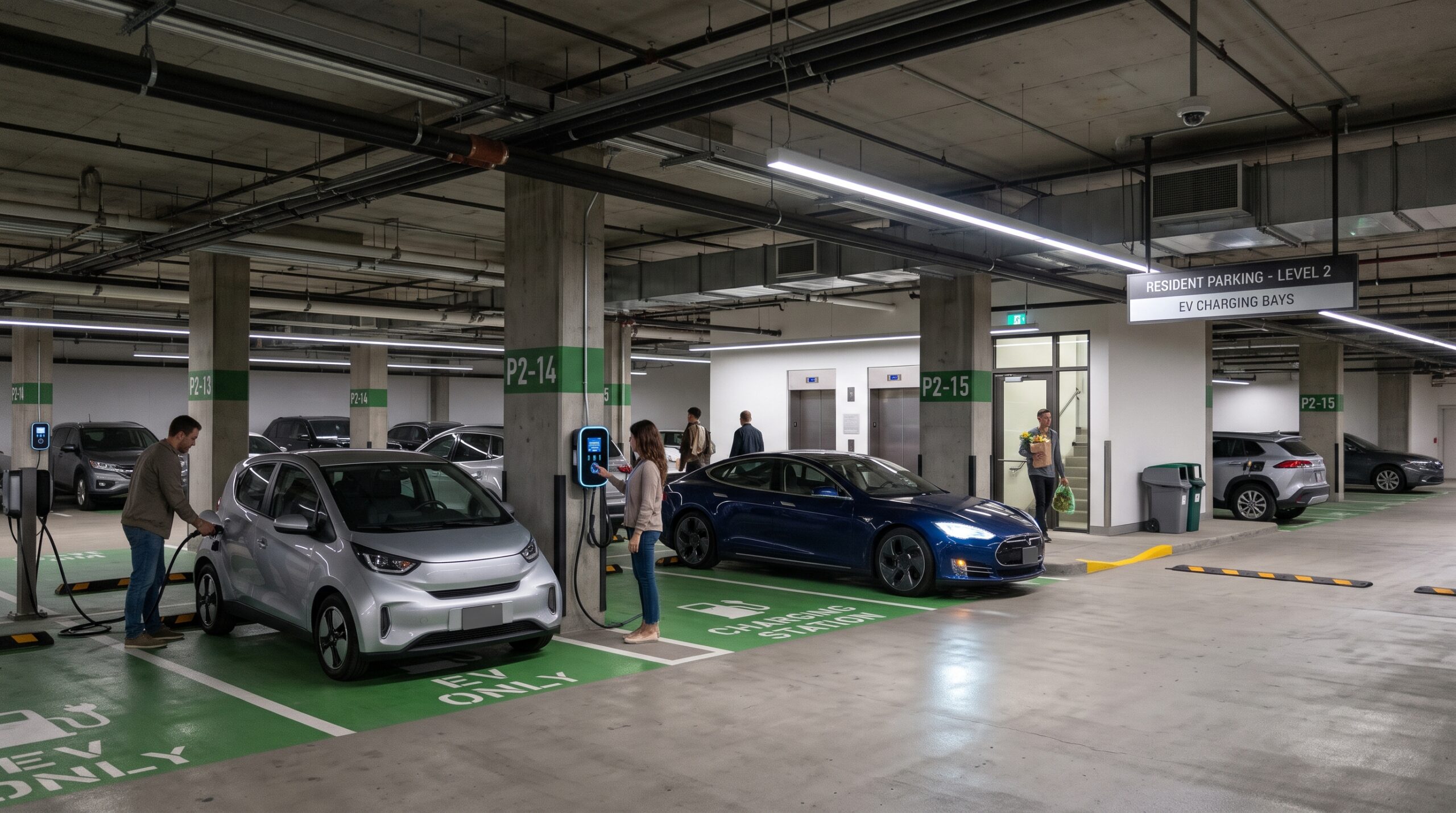
Canada’s electric vehicle (EV) infrastructure continues to evolve as industry organizations, utilities, and charging providers work to improve charging accessibility and support the transition toward cleaner transportation. This week’s developments highlight opportunities to expand residential EV charging, introduce more efficient fast-charging technology, and strengthen charging networks that benefit local communities and businesses.
From growing investment opportunities in multi-unit residential buildings to upgraded charging hubs in British Columbia and new public charging stations in Ontario, these initiatives demonstrate how EV infrastructure development can support economic growth, improve accessibility, and advance transportation electrification.
1. Expanding Residential EV Charging Creates New Business Opportunities Across Canada
The Canadian Charging Infrastructure Council (CCIC) and Electric Mobility Canada (EMC) have launched a national initiative aimed at tripling the number of EV-ready and charger-equipped parking spaces in apartment and condominium buildings across Canada. The initiative highlights the growing importance of residential charging infrastructure in supporting EV adoption and creating opportunities for the charging and real estate industries.
Approximately one-third of Canadian households live in multi-unit residential buildings, where access to home EV charging is often more limited than in detached homes. With approximately 80% of EV charging in Canada occurring at home, expanding charging accessibility in residential buildings could help make electric vehicle ownership more practical for a wider range of Canadians.
From a business perspective, the expansion of residential EV charging presents opportunities for property developers, building owners, electrical contractors, charging equipment providers, and energy management companies. Integrating EV-ready infrastructure into new developments and upgrading existing buildings could help meet growing demand for convenient charging solutions.
Cost efficiency is another important consideration. Research by Dunsky Energy + Climate Advisors estimates that wiring an entire residential building for EV charging with energy management systems could cost approximately $4,240 per parking space in net present terms. In comparison, installing chargers individually could cost approximately $6,290 per space, representing a 48% increase. These findings highlight the potential financial advantages of coordinated, building-wide charging infrastructure.
EV adoption also offers potential long-term savings for consumers. According to an analysis by Clean Energy Canada cited by the industry groups, a typical EV driver could save between $23,000 and $32,000 over 10 years compared with operating a gasoline-powered vehicle.
However, EV-ready requirements and charging infrastructure regulations currently vary across Canada. British Columbia and Quebec have provincial EV-ready legislation, while more than 60 municipalities have introduced requirements for new buildings. The industry initiative also calls for coordinated funding, building retrofits, and national model building code updates to support infrastructure expansion.
Utilities and charging providers have expressed support for broader charging access, while emphasizing the importance of electrical grid planning and upgrades to accommodate increasing electricity demand safely and reliably.
As residential charging becomes increasingly important to transportation electrification, strategic investment in building infrastructure and energy management technology could help property owners improve cost efficiency while supporting Canada’s longer-term EV adoption objectives.
2. BC Hydro Expands South Surrey Fast-Charging Hub with Advanced Power-Sharing Technology
BC Hydro has enhanced its electric vehicle fast-charging hub at the South Surrey Superstore, expanding charging capacity and introducing technology designed to improve infrastructure utilization and charging accessibility.
Located at 2332 160 Street in Surrey, British Columbia, the upgraded facility features six 180-kilowatt fast chargers capable of serving up to 12 electric vehicles simultaneously. Under suitable charging conditions, the chargers can add up to 180 kilometres of driving range to an average EV in approximately 10 minutes.
A key feature of the upgraded site is its intelligent power-sharing technology. Each 180-kilowatt charger can distribute electricity between two vehicles, allowing both to charge at the same time. For example, a single unit can provide 90 kilowatts to each of two connected EVs.
This approach enables charging infrastructure to accommodate more vehicles through shared charger capacity, helping improve charging accessibility and the utilization of available charging equipment.
The charging hub also supports CCS, CHAdeMO, and NACS connectors, providing compatibility with a broad range of electric vehicles.
Beyond the South Surrey location, BC Hydro operates nine additional EV charging sites throughout Surrey, including public recreation centres, transportation facilities, and community locations. Together, its ten Surrey sites provide a combined 95 charging ports.
The expansion demonstrates how utilities can strengthen public EV charging networks through high-powered charging equipment and smarter energy distribution. By increasing charging capacity and supporting multiple connector standards, these improvements can make public charging more convenient and help accommodate growing demand for electric mobility.
The South Surrey upgrade also highlights the role of power-sharing technology in the continued development of efficient, accessible EV charging infrastructure.
3. New Huntsville EV Fast-Charging Station Supports Cleaner Transportation and Local Tourism
Lakeland EV Charging, in partnership with the District of Muskoka, has opened a new public EV fast-charging station along Highway 60 in Huntsville, Ontario. The project expands charging accessibility for local residents and visitors travelling toward Algonquin Park while supporting the region’s tourism economy and transition toward cleaner transportation.
Located at 330 Highway 60 on the District of Muskoka’s water treatment plant property, the station features four 240-kilowatt fast-charging ports. Two ports use CCS connectors, while the other two support NACS, making the facility accessible to a wider range of electric vehicles. The installation is among Lakeland EV Charging’s first sites to support both connector types.
Strategically located along a popular tourism route, the station provides EV drivers with an additional charging option when travelling between Huntsville and Algonquin Park. Nearby attractions, including Fairy Vista Trail and local businesses, offer opportunities for visitors to explore the surrounding community while their vehicles charge.
Beyond providing charging infrastructure, the project demonstrates how EV charging stations can support local economic activity by improving accessibility and encouraging visitors to spend time in nearby communities.
The initiative also illustrates the value of partnerships in expanding clean transportation infrastructure. The District of Muskoka is providing the site through a long-term lease at no cost, while the project received funding support through federal and provincial charging infrastructure programs, including the Zero Emission Vehicle Infrastructure Program and Ontario’s ChargeON initiative.
The Huntsville installation builds on an existing partnership established in 2024. Its first joint charging project opened in 2025 at The Pines, a long-term care facility in Bracebridge, where four Level 2 charging ports were installed.
With additional fast-charging capacity along a key regional route, the new station offers residents and travellers more transportation options while helping strengthen public EV charging infrastructure in Muskoka.
The project reflects how collaboration among charging providers, communities, and funding partners can contribute to cleaner mobility, regional connectivity, and local economic development.
Looking Ahead
These developments highlight the importance of expanding EV charging infrastructure across residential, urban, and regional environments.
Investment in apartment and condominium charging infrastructure could create new opportunities for property developers and charging providers, while improved power-sharing technology can help utilities and charging operators make more effective use of charging equipment.
At the community level, strategically located charging stations can improve access to cleaner transportation while supporting local tourism and businesses.
As Canada’s EV charging network continues to develop, infrastructure investment, energy management technologies, and partnerships across industries will remain important in making electric mobility more accessible, efficient, and practical.
Stay Connected
Stay informed about the latest developments in renewable energy, electric vehicle infrastructure, and clean transportation technologies.
Follow us for more insights into the innovations, investments, and projects shaping Canada’s transition toward a cleaner and more sustainable energy future.
👉 Connect with us on LinkedIn: Energiee Motion
References
- Electric Autonomy Canada – EV groups urge Ottawa to triple charger-ready parking in apartments and condos
https://electricautonomy.ca/charging/multi-unit-buildings/2026-10-22/call-to-triple-charger-ready-murb-parking/ - BC Hydro – BC Hydro enhances its fast-charging site in South Surrey
https://www.bchydro.com/news/press_centre/news_releases/2026/ev-site-south-surrey-superstore.html - Bayshore Broadcasting – New Huntsville Hwy 60 EV fast chargers power fall-colour trips to Algonquin Park
https://www.bayshorebroadcasting.ca/2026/10/19/new-huntsville-hwy-60-ev-fast-chargers-power-fall-colour-trips-to-algonquin-park/
