
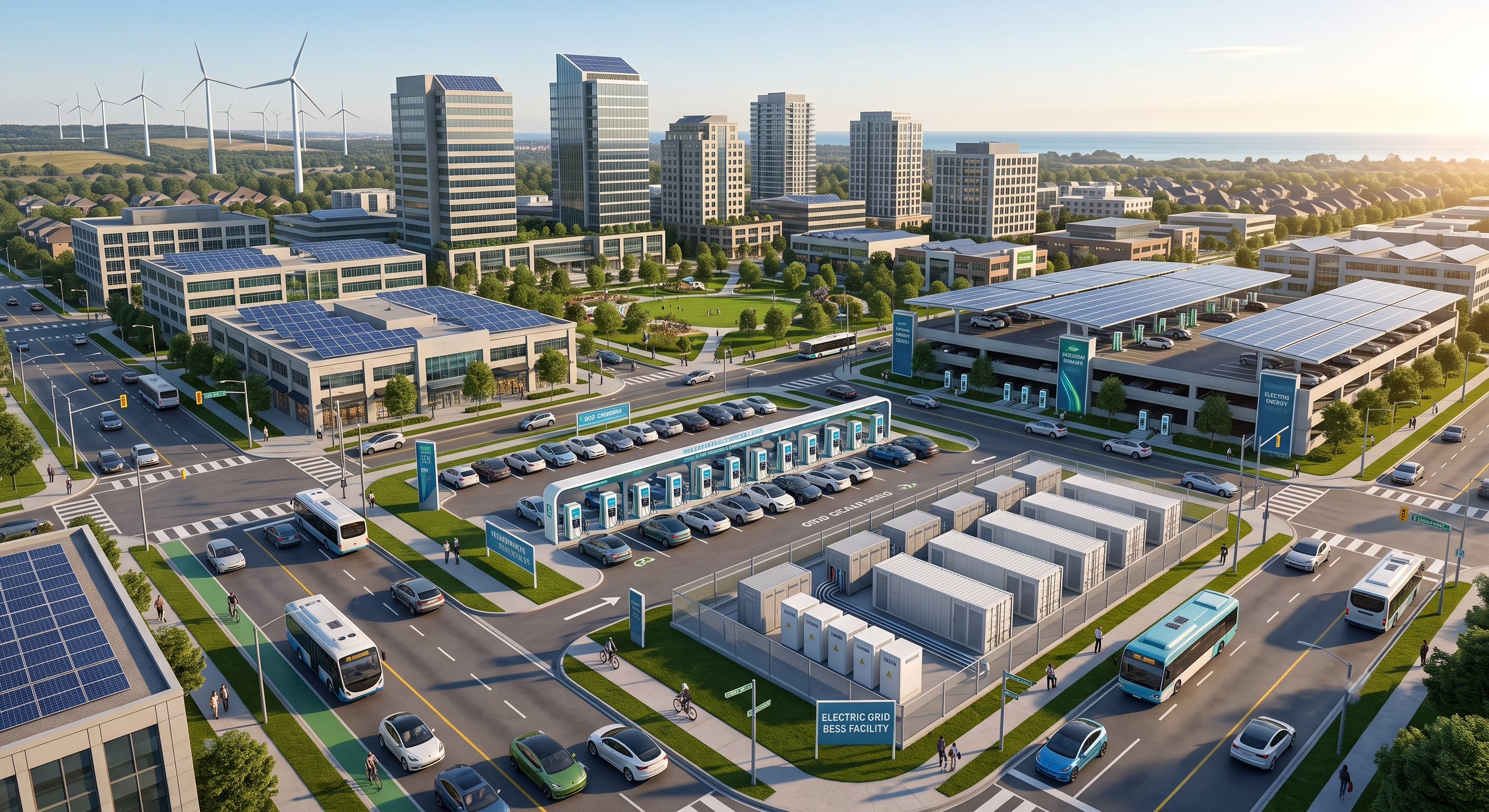
Canada’s transition toward cleaner transportation and a more flexible electricity system continues to advance through new investments in electric vehicle charging and battery energy storage. This week’s developments include federal support for EV infrastructure and education across Canada, a major climate investment expanding charging access in New Brunswick, and BC Hydro’s first competitive procurement process for grid-scale battery energy storage.
1. Federal Investment Expands EV Infrastructure and Education Across Canada
The federal government has announced $10.9 million for 22 electric vehicle infrastructure and education projects across Canada, continuing efforts to make the transition to electric vehicles more accessible for Canadian families and businesses.
Almost $9 million of the funding will support nine projects through the Zero Emission Vehicle Infrastructure Program, resulting in the installation of nearly 400 chargers across Canada. An additional approximately $2 million will support 13 education and awareness projects designed to increase familiarity with electric vehicles and EV charging.
The investment builds on Canada’s broader efforts to accelerate vehicle electrification. In British Columbia, the public charging network has already expanded to more than 8,900 charging ports, representing an 87 percent increase since 2023.
The federal government is also connecting transportation electrification with Canada’s clean electricity advantage. Through the National Electricity Strategy, Canada aims to expand clean power while supporting innovation, economic growth, industrial competitiveness, job creation, and lower emissions.
Together with Canada’s new Auto Strategy, these investments are intended to position the country as a global leader in vehicle electrification and battery supply chains while giving Canadians greater confidence in choosing clean transportation.
2. New Brunswick Invests in Major EV Charging Expansion
The New Brunswick government is investing nearly $64 million through its climate change fund to support 72 projects aimed at reducing greenhouse gas emissions and helping the province transition toward a greener economy. The investment includes three projects focused on expanding electric vehicle charging infrastructure.
A $5 million project will add 16 fast chargers and 29 total charging ports. The Department of Energy and NB Power plan to install new fast-charging ports in locations where private-sector investment has been limited while also increasing capacity at existing high-demand charging locations. The expansion is intended to reduce range anxiety, support EV adoption, and decrease reliance on fossil fuels.
The Department of Transportation and Infrastructure also plans to establish regional charging hubs in Moncton, Saint John, and Miramichi. This work forms part of a $955,000 investment to expand the province’s electric vehicle fleet and install additional charging infrastructure at provincial fleet locations.
Another $100,000 will expand charging infrastructure at République Provincial Park, Mactaquac Provincial Park, and Herring Cove Provincial Park. The additional chargers are intended to improve access for EV-driving visitors while supporting longer stays and the province’s sustainable and regenerative tourism objectives.
These projects support New Brunswick’s broader goal of reaching its 2030 greenhouse gas emissions reduction target and achieving net-zero emissions by 2050.
3. BC Hydro Advances Grid-Scale Battery Storage on Vancouver Island
BC Hydro has launched a competitive procurement process for its first grid-scale battery energy storage system project. The planned facility will provide at least 100 megawatts of battery storage capacity on Vancouver Island to strengthen reliability, improve system flexibility, and help meet growing electricity demand.
Under BC Hydro’s Powering Growth plan, the utility has identified up to 500 megawatts of potential battery storage capacity across British Columbia.
The Request for Supplier Qualifications represents an important step toward developing the Vancouver Island project and potential future battery storage projects elsewhere in British Columbia.
BC Hydro expects to own and operate the facility while drawing on private-sector expertise for design, construction, and potentially long-term maintenance. Direct ownership would allow BC Hydro to operate and dispatch the battery system according to grid and customer needs.
Suppliers will be evaluated based on their experience, technical expertise, and demonstrated ability to design and deliver grid-scale battery energy storage projects. BC Hydro expects to create a shortlist of qualified suppliers that could participate in future competitive procurement processes, including the Vancouver Island Terminal Project and other potential projects across the province.
Looking Ahead
This week’s developments highlight the growing connection between transportation electrification and electricity system modernization in Canada. Expanding public and government EV charging infrastructure can help make electric transportation more practical, while grid-scale battery storage can provide additional flexibility as electricity demand grows and more renewable energy resources are integrated.
From nationwide EV infrastructure investments to provincial charging networks and large-scale energy storage, these initiatives demonstrate how infrastructure, electricity, and transportation planning are increasingly developing together as Canada advances its clean energy transition.
Stay Connected
Stay connected for more renewable energy insights as governments, utilities, and industry continue investing in the infrastructure, technologies, and energy systems shaping Canada’s clean energy future.
👉 Connect with us on LinkedIn: Energiee Motion
References
- Environment and Climate Change Canada – The federal government invests in electric vehicle infrastructure and education across Canada
https://www.canada.ca/en/environment-climate-change/news/2026/07/the-federal-government-invests-in-electric-vehicle-infrastructure-and-education-across-canada.html - CHCO-TV – Province’s $64M climate investment includes major EV charging expansion
https://chco.tv/provinces-64m-climate-investment-includes-major-ev-charging-expansion/ - Island Social Trends – BC Hydro accepting grid-scale battery energy storage system proposals
https://islandsocialtrends.ca/bc-hydro-accepting-grid-scale-battery-energy-storage-system-proposals/
