
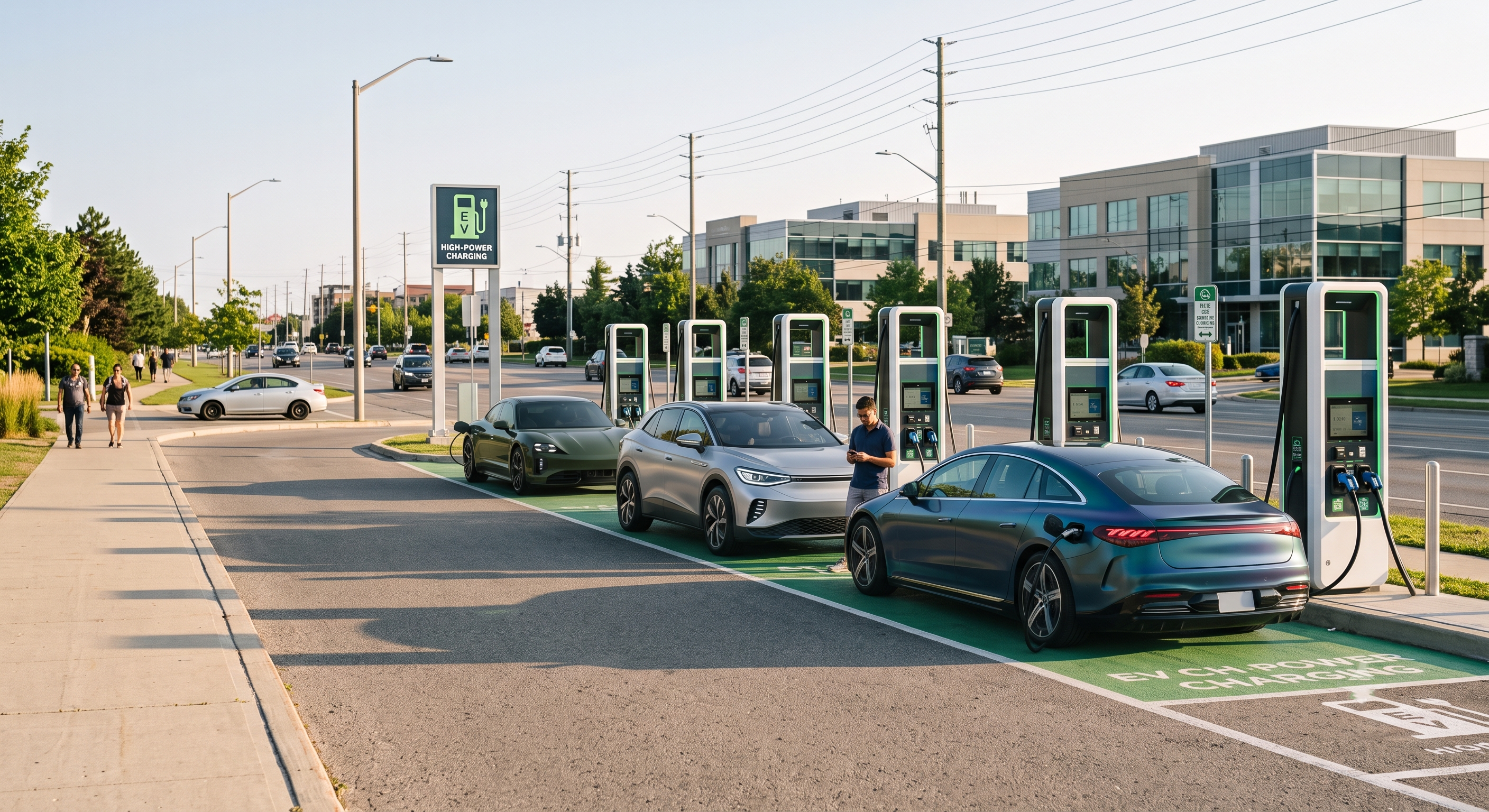
Electric vehicle (EV) charging infrastructure continues to expand across North America as governments and industry work to support growing EV adoption. This week, British Columbia announced a major investment to significantly expand its public charging network, Illinois celebrated the opening of its first federally funded EV charging station while launching another round of charging projects, and Michigan reported continued growth in charging availability with improved access for residents. Together, these developments highlight ongoing efforts to improve charging convenience, strengthen transportation networks, and accelerate the transition to cleaner mobility.
1. British Columbia Accelerates Provincewide EV Charging Expansion
British Columbia is making a major investment in its electric vehicle charging network through BC Hydro’s plan to deploy 3,500 new public charging ports by 2035. Supported by a $700 million investment, the initiative will more than triple BC Hydro’s existing network, making it one of Canada’s largest public charging systems.
New charging hubs will be built in communities across the province, along major highway corridors, and in high-demand urban areas to support the growing number of electric vehicles on B.C. roads. The expansion introduces standardized charging site designs that improve accessibility, reliability, maintenance efficiency, and the overall customer experience.
BC Hydro will also upgrade charging technology by making 200-kilowatt chargers the network standard while introducing 400-kilowatt ultra-fast chargers at selected high-demand locations. New customer-focused features, including plug-and-charge capability and tap-to-pay functionality, will simplify charging while reducing wait times through larger charging hubs.
The expansion builds on the success of B.C.’s Electric Highway and complements additional provincial funding through the CleanBC Go Electric Public Charger Program, which is investing approximately $18 million in new public fast chargers with a focus on Indigenous, rural, northern, and high-demand communities.
As of April 2026, British Columbia has more than 238,000 registered light-duty zero-emission vehicles and over 8,900 public charging ports. The province’s zero-emission vehicle sector contributed $2.1 billion to the economy in 2025 while supporting approximately 16,400 jobs.
2. Illinois Opens First Federally Funded EV Charging Station
Illinois has officially opened its first electric vehicle charging station built through the National Electric Vehicle Infrastructure (NEVI) Program, marking an important milestone in the state’s charging network expansion.Located at a Mach 1 fuel station near Interstate 70 in Casey, the new facility features four DC fast chargers.
Alongside the opening, the Illinois Department of Transportation announced $23.5 million in additional funding for 29 new charging projects that will add 140 public charging ports across the state. Each site will include at least four DC fast chargers capable of charging a typical electric vehicle in less than 30 minutes.
The expanding network supports Illinois’ goal of placing one million electric vehicles on the road by 2030 while improving charging access along major highways and creating new economic opportunities for rural communities by encouraging travelers to stop and support local businesses.
3. Michigan Reports Strong Growth in EV Charging Access
Michigan continues to strengthen its public charging infrastructure, according to a new analysis by Anderson Economic Group. As of July 2026, the state has 569 public DC fast charging stations and 1,721 Level 2 charging stations, reflecting significant growth over the past year.
During 2025, Michigan added 125 public DC fast charging stations, representing approximately 32% growth compared to the previous year, with another 55 stations becoming operational in early 2026. The state’s expansion closely matches the national growth rate for DC fast charging infrastructure.
The study found that most fast charging stations remain concentrated in urban areas such as Detroit, Ann Arbor, Lansing, Grand Rapids, and Kalamazoo, while more limited coverage exists in northern Michigan and the Upper Peninsula.
Improved charging availability has increased the share of Michigan residents living within a 10-minute round trip of a DC fast charging station from 19% in 2024 to approximately 32.2% today. Although access continues to improve, this remains below the accessibility of traditional fuel stations, where more than 90% of residents live within a similar distance.
Researchers also noted that charging infrastructure remains an important factor influencing electric vehicle adoption, making continued investment valuable for consumers considering the transition to electric transportation.
Looking Ahead
North American governments and industry continue investing in public charging infrastructure to improve accessibility, reduce range concerns, and support increasing electric vehicle adoption. As charging networks become larger, faster, and more reliable, they will play an increasingly important role in enabling the transition toward cleaner transportation.
Stay Connected
Stay informed with the latest renewable energy developments as we continue tracking innovations, investments, and policies shaping the future of sustainable transportation and clean energy across North America.
👉 Connect with us on LinkedIn: Energiee Motion
References
- BC Gov News – BC Hydro expanding public EV charging network with 3,500 new charging ports by 2035
https://news.gov.bc.ca/releases/2026ECS0041-000855 - The Daily Gate City / The Hawk Eye – Illinois first federally funded EV charging station opens in Casey
https://whig.com/2026/07/23/illinois-first-federally-funded-ev-charging-station-opens-in-casey/ - Anderson Economic Group – Michigan’s EV Charging Station Network Expanded in 2025; Access Has Improved
https://www.andersoneconomicgroup.com/michigans-ev-charging-station-network-expanded-in-2025-access-has-improved/
