
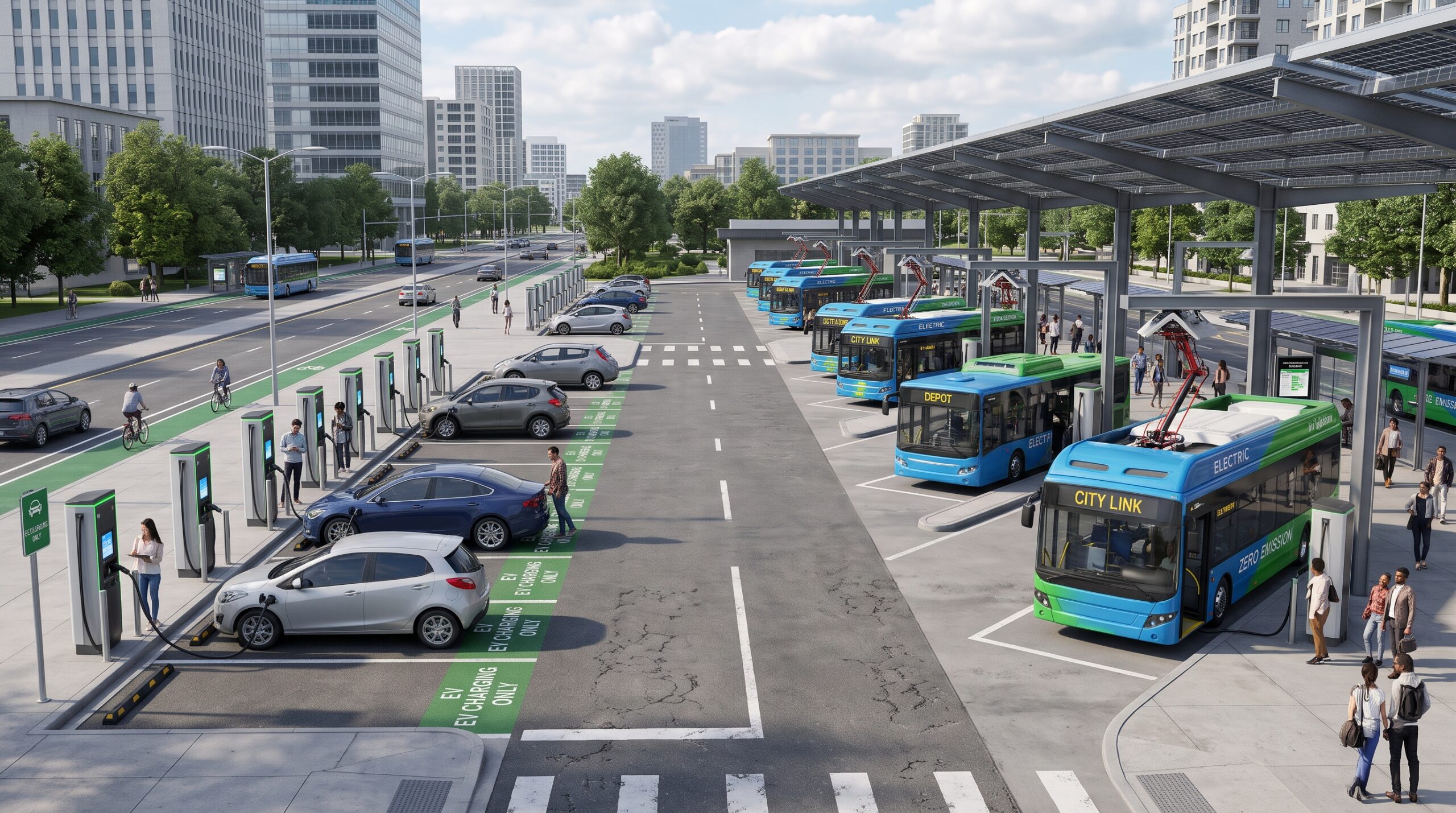
This week’s renewable energy developments highlight the growing role of infrastructure investment, public-sector collaboration, and innovative financing in advancing transportation electrification across North America. Canada is proposing significant investments in electric vehicle charging and grid modernization, Washington State has introduced its first electric bus base, and Connecticut is pioneering an electric school bus fleet equipped with vehicle-to-grid technology. Together, these developments demonstrate how cleaner transportation and stronger electricity systems can support a more sustainable energy future.
1. Canada Proposes Major EV Charging and Grid Modernization Investments
Canada’s 2026 federal budget proposes more than $634 million for electric vehicle (EV) charging infrastructure, including $587 million to renew the Zero-Emission Vehicle Infrastructure Program (ZEVIP). Subject to parliamentary approval, the renewed program would provide funding over five years beginning in 2027, supporting more than 55,000 additional chargers in areas where infrastructure is most needed. The investment aims to approximately double the number of federally supported chargers.
ZEVIP supports public EV charging projects by covering up to 50% of eligible project costs, or up to 75% for Indigenous-led projects, with funding capped at $2 million per project. The five-year extension is expected to provide greater certainty for charging infrastructure developers, helping them plan projects and secure financing.
The Canadian Charging Infrastructure Council highlighted the importance of addressing charging accessibility in condominiums and apartments, expanding public fast charging along major corridors and in metropolitan areas, and supporting commercial fleets and medium- and heavy-duty vehicles.
Canada has already supported more than 50,000 charging installations. Under existing ZEVIP funding, the government projects that 58,874 chargers will be operational or planned by 2028-29. Ontario is expected to account for 23,802 chargers, followed by British Columbia with 17,147, Quebec with 9,555, and the Northwest Territories with 42.
Beyond charger deployment, the budget proposes $45 million over five years for charging technology research and development through Natural Resources Canada. An additional $2.2 million would support the Greening Government Operations Fleet Program, which assesses federal departments’ readiness to adopt zero-emission vehicles.
The investments form part of the broader Powering Canada Strong electricity strategy, backed by more than $50 billion and aimed at doubling Canada’s electricity grid capacity by 2050. Nearly $4 billion over 10 years is proposed for electricity infrastructure expansion, renewable energy development, and priority grid projects, including the Smart Renewables and Electrification Pathways Program.
Further measures include $37 million to study interprovincial and territorial electricity transmission connections, $26.4 million over 10 years for grid planning data and modelling, and $1.6 billion over 10 years to modernize electricity systems in northern and remote communities. The budget also proposes expanding the Clean Electricity Investment Tax Credit to cover the highest-voltage transmission lines within provinces and extending both the Clean Electricity and Clean Technology investment tax credits through 2040.
Despite the positive reception, industry representatives identified remaining gaps. The budget does not provide additional funding for medium- and heavy-duty electric vehicles, EV education, or battery recycling. Canada’s Incentives for Medium- and Heavy-Duty Zero-Emission Vehicles program ended on March 15, 2026, without a federal replacement.
Overall, the proposed investments represent a significant step toward expanding EV charging accessibility while strengthening the electricity infrastructure required to support wider transportation electrification.
2. Washington State Opens Its First Electric Bus Base with Capacity for 120 Buses
Washington State has introduced its first electric bus base through a partnership between King County Metro and Seattle City Light. The new Tukwila Bus Base, one of the largest electric bus facilities in the United States, has the charging capacity to support 120 electric buses.
The facility represents a major advancement in the region’s transition toward zero-emission public transportation. By replacing conventional diesel-powered operations with electric buses, the project aims to reduce exhaust emissions and noise pollution while improving air quality and creating quieter neighborhoods.
Tukwila Base is powered by carbon-neutral electricity purchased by King County Metro from Seattle City Light. This approach combines cleaner electricity with zero-emission transportation and helps reduce dependence on fluctuating fuel prices, supporting the long-term affordability and reliability of public transit services.
The project builds on more than five decades of collaboration between the two public agencies. Their partnership began in 1973 during an oil embargo that increased fuel prices and encouraged investment in dependable electric transit. King County Metro expanded its zero-emission trolley bus network, while Seattle City Light developed dedicated electrical substations. By 2000, the utility had constructed more than 40 substations supporting electric transportation.
In 2021, the agencies shifted their focus toward battery-electric buses and established a test facility at South Base. The operational experience gained from testing charging depot systems helped guide the design and development of Tukwila Base.
As King County Metro’s first zero-emission bus base, the facility will serve as a foundation for future depot conversions. Seattle City Light will focus on expanding electrical grid capacity, while King County Metro will manage charging infrastructure procurement and testing. South Base will continue evaluating emerging technologies to determine whether they meet operational requirements.
The Tukwila project demonstrates how long-term cooperation between transit operators and electricity providers can accelerate fleet electrification. Its infrastructure, operational experience, and collaborative approach offer a practical model for expanding affordable, reliable, and sustainable public transportation.
3. Connecticut Advances Electric School Transportation with Vehicle-to-Grid Technology
Connecticut has reached a significant milestone in school transportation electrification through an $11.3 million financing agreement between the Connecticut Green Bank and Zum Services, Inc. The investment supports the deployment of 46 electric school buses, 49 vehicle-to-grid (V2G) capable chargers, and associated electrical infrastructure for Branford Public Schools.
The project establishes Connecticut’s first fully electric school bus fleet and the largest fully electric school district fleet with V2G capability in the Northeast United States. Electric buses began entering service during the 2026-2027 school year, supporting a transition toward cleaner, quieter, and more sustainable student transportation.
The financing covers electric bus acquisition, bidirectional charging equipment, and the electrical infrastructure required at Zum’s Branford bus yard. It also builds on a long-term transportation services agreement between Zum and Branford Public Schools.
A key feature of the project is its V2G-ready infrastructure, which creates the potential for electric school buses to return stored battery energy to the electricity grid during periods of high demand. This capability could transform school buses from transportation assets into flexible energy resources that contribute to grid resilience.
On October 29, Connecticut’s Public Utilities Regulatory Authority published a Proposed Final Decision approving the participation of commercial bidirectional EV charging systems in the state’s Energy Storage Solutions Program beginning in 2027. The Connecticut Green Bank, which co-administers the program, plans to collaborate with Zum and Eversource to support the state’s first commercial V2G charging project.
The initiative also introduces an innovative financing approach that combines grant funding with low-cost financing. This blended funding structure is designed to reduce project costs, generate budget savings for Branford Public Schools, and offer a replicable model for other school districts considering electric fleet adoption.
Beyond financial benefits, the project aims to reduce students’ exposure to harmful vehicle emissions, improve air quality for drivers and surrounding communities, lower carbon emissions, and provide quieter transportation.
The project aligns with Connecticut’s statutory zero-emission school bus deployment goals. By combining electric school buses, bidirectional charging technology, and innovative financing, the Branford project demonstrates how educational transportation systems can contribute to both environmental sustainability and future electricity grid resilience.
Looking Ahead
These three developments highlight the importance of combining transportation electrification with reliable electricity infrastructure, supportive financing mechanisms, and coordinated implementation.
Canada’s proposed investments could strengthen charging accessibility and grid capacity, Washington’s Tukwila Bus Base demonstrates the value of utility and transit agency collaboration, and Connecticut’s electric school bus project introduces opportunities for vehicle batteries to support the electricity network.
As electrification progresses, the ability to scale infrastructure, improve cost efficiency, and integrate transportation with cleaner electricity systems will remain central to building a more resilient and sustainable energy future.
Stay Connected
Stay connected for more renewable energy insights, industry developments, and emerging technologies shaping the global transition toward cleaner energy and sustainable transportation.
Follow our updates to explore how infrastructure investment, electric mobility, and energy innovation are transforming communities and industries.
👉 Connect with us on LinkedIn: Energiee Motion
References
- Electric Autonomy – Federal budget pairs $587-million EV charger funding with $4-billion grid push
https://electricautonomy.ca/policy-regulations/2026-11-06/federal-budget-ev-charger-grid-funding/ - Seattle City Light (Powerlines) – Washington’s First Electric Bus Base
https://powerlines.seattle.gov/2026/11/10/washingtons-first-electric-bus-base/ - Connecticut Green Bank – Connecticut Green Bank Closes Financing with Zum to Support Connecticut’s First Fully Electric School Bus Fleet for Branford Public Schools
https://www.ctgreenbank.com/zum-financing-supports-first-fully-electric-school-bus-fleet-in-state-for-branford-public-schools/
